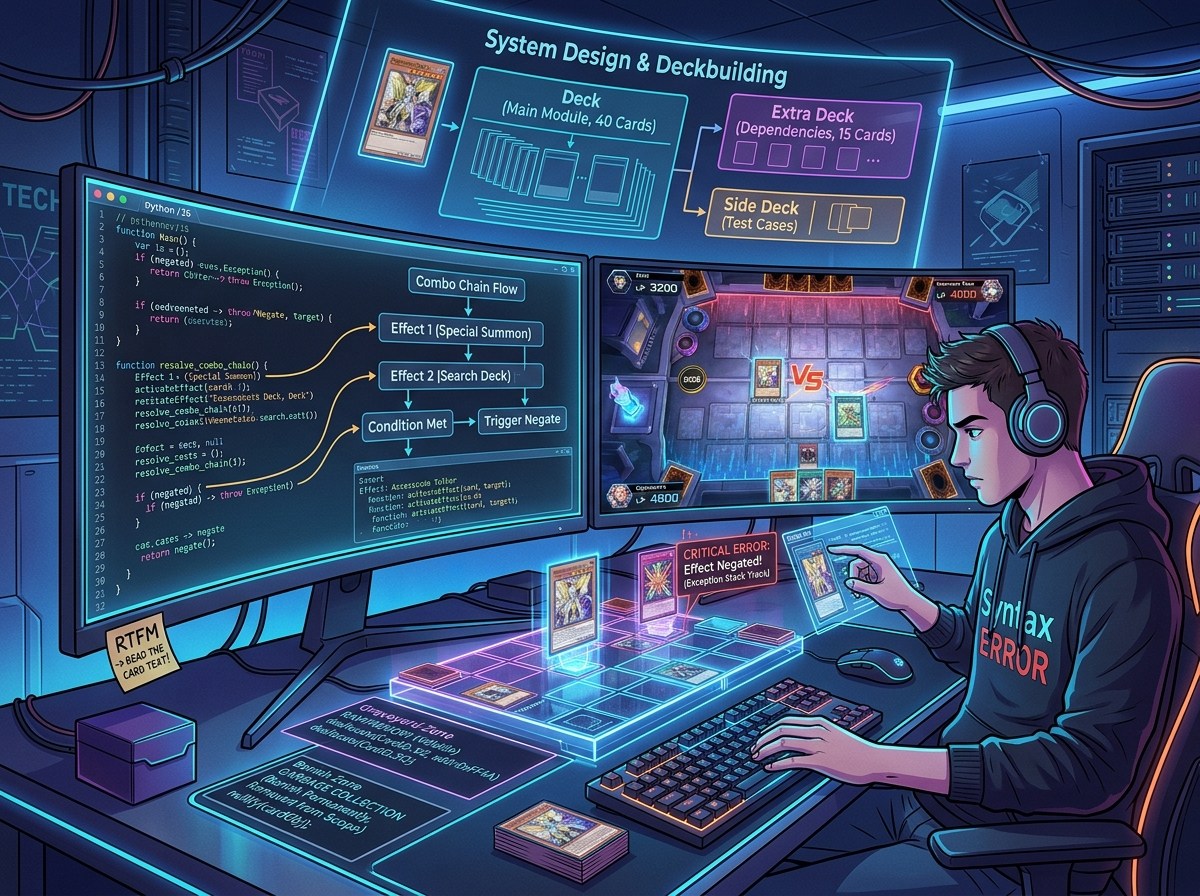
If you’re a programmer looking at Yu-Gi-Oh! in 2026, the first thing to understand is this: the game is not really “a card game” in the cozy sense people mean when they say “card game.” It is closer to a real-time strategy engine built on 25 years of legacy code, weird edge cases, and surprisingly elegant optimization problems.
Which is probably why programmers tend to click with it.
At a distance, Yu-Gi-Oh! looks chaotic. Someone normal sees a player summon five monsters, search three cards, negate two effects, banish something face-down, and then explain a chain interaction using wording that sounds like a database migration written by a poet under duress. A programmer, meanwhile, sees a system. There are resources, dependencies, triggers, failure states, recursion risks, timing windows, and a deeply held belief that if you read the text carefully enough, the behavior is technically correct.
That last part should already feel like home.
Modern Yu-Gi-Oh! rewards the same instincts that make someone decent at programming. Deckbuilding is architecture. You are not just choosing “good cards”; you are designing a system that should produce reliable outputs under hostile conditions. Your starters are entry points. Your extenders are fallback methods. Your garnets are that one embarrassing hardcoded dependency that works beautifully until it appears in your opening hand and ruins your day. A strong deck is not just powerful. It is consistent, resilient, and capable of recovering when reality refuses to match the happy path.
Playing the game feels even more like coding than building the deck. Every turn is a sequence of operations where ordering matters, hidden information matters, and one premature commit can destroy the whole program. A combo line is basically a function: given this hand and this board state, produce an end board. Good players don’t just memorize the line; they understand the logic behind it. If the opponent interrupts at step three, can you reroute? Can you preserve enough material for a smaller but still acceptable output? Can you identify when you are overextending into obvious interaction like a developer pushing untested code straight to production on a Friday afternoon?
And yes, Yu-Gi-Oh! absolutely has the equivalent of runtime errors. They are called “misplays,” and unlike in software, you usually discover them immediately and in public.
What makes Yu-Gi-Oh! especially appealing to programmers is that strategy in this game is less about vague instinct and more about constrained problem-solving. You are constantly evaluating lines with incomplete information. What is the likely range of responses from your opponent? Which effect is the actual bottleneck? What resource matters most: cards in hand, bodies on board, graveyard setup, once-per-turn effects, or the normal summon? The best move is often not the flashiest one. It is the one that preserves optionality. In other words, the game rewards developers who already know that the cleanest solution is often better than the cleverest one.
Then there’s the metagame, which is where the “programmers should try Yu-Gi-Oh!” argument becomes even stronger. Learning Yu-Gi-Oh! in 2026 is not just learning the rules. It is learning the environment. A deck does not exist in isolation any more than an application exists in a vacuum. It exists in production, where other systems are trying to break it. You need to know what people are playing, what interaction is common, what choke points matter, and which tech choices are actually useful instead of merely cute. This is less “I brought my favorite cards” and more “I deployed against the current ecosystem.”
That may sound intimidating, but it is also why the game stays interesting. There is always another optimization. You tweak ratios, alter your side deck, test different hand traps, revise your sequencing, and discover that one card you dismissed three weeks ago is actually the missing patch note your list needed. Yu-Gi-Oh! scratches the same mental itch as performance tuning: the system already works, but you know it could work better.
It also shares programming’s occasionally absurd relationship with documentation. In Yu-Gi-Oh!, words matter with almost comic precision. “If” and “when” matter. “Then” matters. Targeting matters. Sending something to the graveyard is not destroying it, which sounds ridiculous until you realize programmers also live in a world where null, undefined, and false are somehow different species of pain. The rules text is not flavor. It is the spec. Ignore that at your peril.
For programmers getting into the game in 2026, the healthiest mindset is not “I need to know every card.” That way lies madness. The better mindset is “I need to recognize patterns.” Learn what starters do. Learn what extenders do. Learn what interruption looks like. Learn the common board-breaking tools. Learn where decks bottleneck. Once you see the abstractions, the card pool becomes much less terrifying. You stop trying to memorize the whole internet and start reading game states like systems.
And perhaps that is the funniest reason Yu-Gi-Oh! feels so natural to programmers: both hobbies are fundamentally about creating order in an environment that resists it. You write code because you want a machine to behave predictably. You play Yu-Gi-Oh! because you want chaos to resolve in your favor, ideally after summoning a monster with a name that sounds like a failed open-source project and an eldritch satellite.
So if you program and you have been curious about Yu-Gi-Oh!, 2026 is actually a great time to jump in, provided you accept one truth early: this game is not old-school playground nonsense where the strongest dragon wins. It is strategy, sequencing, probability, pattern recognition, and technical literacy wearing anime shoulder pads.
Which, honestly, makes it one of the most programmer-friendly games around.
Leave a Reply