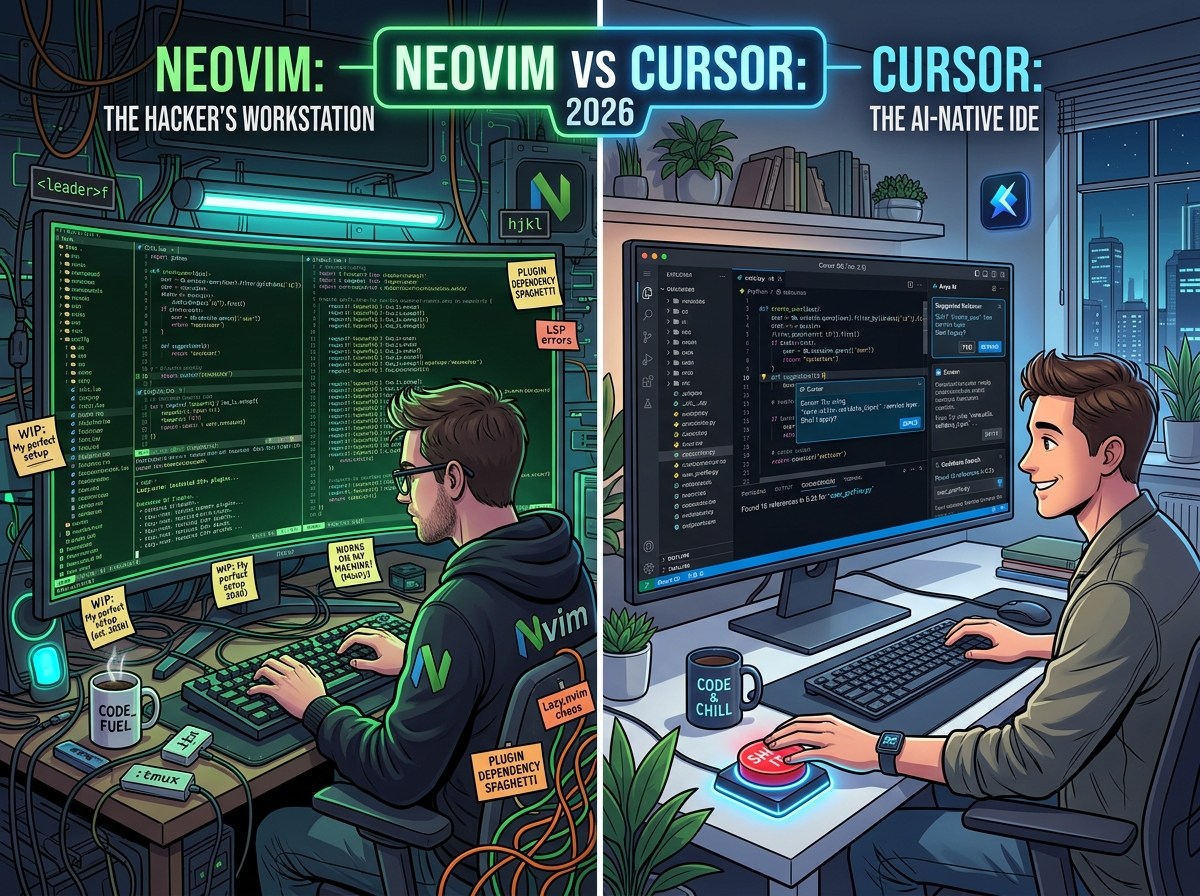
If you hang around programmers long enough, you will eventually discover that text editors are not tools so much as belief systems. NeoVim users tend to speak about their setup the way medieval scholars discussed illuminated manuscripts: with reverence, footnotes, and the occasional warning that true power only comes after suffering. Cursor users, meanwhile, tend to sound like people who have seen the future and are mildly annoyed everyone else is still hand-compiling their own sense of identity.
In 2026, the NeoVim vs Cursor debate is really a debate about what kind of pain you consider noble.
NeoVim is brilliant. It is fast, deeply customizable, keyboard-centric, and capable of becoming almost anything you want. If you enjoy building your own environment, tuning workflows down to the keystroke, and shaving milliseconds off your editing loop like a Formula 1 mechanic with a Lua dependency habit, NeoVim is still one of the most satisfying tools in programming. A well-configured NeoVim setup can feel less like an editor and more like telepathy with syntax highlighting.
But there is an important catch, and it is a very programmer catch: NeoVim often turns “editing code” into “maintaining the machine that edits the code.” You open your editor to write software, and half an hour later you are debugging a plugin conflict, reading issue threads, and asking yourself whether your completion source should lazy-load on InsertEnter. At some point, the editor becomes your side project, which is fun right up until you remember you already had a side project, and it was the thing paying your rent.
Cursor, by contrast, is what happens when an IDE looks at all that ritual and says, very politely, “What if we just helped you finish the work?”
That is the strongest case for Cursor, and in 2026 it is a very strong case. Cursor is biased toward output. It assumes that modern programming is no longer just typing text into a file with unusual confidence. It assumes you are reading large codebases, jumping between files, making architectural changes, refactoring old logic, writing tests, explaining code to yourself, and increasingly collaborating with AI as a normal part of the workflow rather than a weird sidecar. Cursor is built around that reality.
This is where the NeoVim purist sometimes has a rough time. NeoVim is superb at editing. Cursor is better at development.
That distinction matters. Editing is the act of changing text. Development is the act of understanding systems, making decisions, and shipping results. Cursor’s real advantage is not that it can autocomplete faster or put a chatbot next to your file. It is that it treats the whole codebase as the unit of work. It helps you reason across files, ask questions in context, generate or revise code with awareness of surrounding structure, and move from “I know roughly what I want” to “this now exists and probably compiles” with much less friction.
NeoVim can absolutely be extended in that direction, of course. That is the standard response, and technically it is true in the way Linux users are technically correct when they say desktop audio can be made pleasant with enough dedication. But “can be extended” is not the same as “is natively better.” Much of the NeoVim argument relies on potential energy. Cursor cashes that out into kinetic energy. It starts closer to useful.
And that is the uncomfortable truth in this comparison: Cursor is not winning because NeoVim is bad. Cursor is winning because most programmers are not actually trying to become elite editor monks. They are trying to solve tickets, build products, understand legacy code, survive meetings, and go home with enough remaining willpower to heat food. For that life, convenience is not moral weakness. It is good tooling.
There is also a cultural reason Cursor has the advantage. NeoVim appeals to the part of programmers that loves mastery. Cursor appeals to the part that loves leverage. Mastery is admirable. Leverage pays astonishing dividends. If a tool helps you navigate complexity faster, reduce boilerplate, explain unfamiliar code, and stay in flow longer, it is not “cheating.” It is the whole point of software tools in the first place. No one wins a medal for manually suffering through things a good system could handle.
That said, bias toward Cursor should not become propaganda. NeoVim still has real advantages. It is lighter, sharper, more composable, and often more pleasant for people who think in motions rather than panels. It can feel incredibly direct in a way large IDEs rarely do. It also has a kind of durability: once you really know NeoVim, that knowledge sticks. You are not just using a product; you are acquiring a portable editing language. Cursor, by comparison, is better as a work platform than as a philosophical lifestyle.
But if the actual question is, “Which one should most developers use in 2026?” the answer is probably Cursor.
Not because it is purer. Not because it is more hardcore. Quite the opposite. Because it is better aligned with what programming now is: high-context, fast-moving, collaborative, AI-assisted, and constantly shaped by the need to understand more code than any one person wants to read line by line. Cursor meets that moment more naturally than NeoVim does.
NeoVim remains an excellent editor for people who want control.
Cursor is the better environment for people who want progress.
And in the eternal conflict between beautifully tuned craftsmanship and simply getting the thing done, “getting the thing done” has a suspicious habit of winning in production.