Blog

  • Is PHP Still Relevant? Absolutely — And Here’s Why It’s Still a Powerhouse in 2026

    Is PHP Still Relevant? Absolutely — And Here’s Why It’s Still a Powerhouse in 2026

    For the last decade, developers have loved declaring PHP “dead.” Meanwhile, PHP has quietly continued running a massive portion of the modern internet, powering everything from small business sites to enterprise-scale platforms. The truth is simple:

    PHP never went away.
    PHP never stopped evolving.
    And PHP is more powerful today than it has ever been.

    SUBSCRIBE WITH THIS OFFER

    Let’s dig into why.

    1. PHP Powers the Majority of the Web — Still

    PHP remains at the core of the platforms that run the internet:

    • WordPress (43% of the web), WooCommerce, Drupal, Joomla, Magento, Laravel

    Even huge brands rely on PHP behind the scenes — Facebook originally ran on PHP and still uses a PHP-based infrastructure (HHVM + Hack).

    Despite all the noise about newer languages, PHP continues to be the silent backbone of the internet. It’s the engine behind the world’s most widely used platforms—WordPress alone powers nearly half of the web, with WooCommerce, Drupal, Joomla, Magento, and Laravel stacked on top of it. Even tech giants aren’t exempt; Facebook’s early success was built on PHP, and its infrastructure still heavily depends on PHP-derived technologies like HHVM and Hack. The truth is simple: if PHP vanished tomorrow, an enormous chunk of the digital world would go dark. The internet doesn’t just use PHP—it depends on it.

    If PHP disappeared tomorrow, half of the internet would break.

    2. PHP Has Evolved Dramatically

    People who say PHP is outdated usually haven’t looked at it since PHP 5.

    Modern PHP (8.0–8.3) includes:

    • Typed properties
      Union types
      Attributes (annotations)
      JIT compiler improvements
      Enums
      Fibers
      Named arguments
      Readonly classes and properties
      Performance boosts that rival Node.js and Python

    Modern PHP feels closer to TypeScript or Kotlin than the PHP of 15 years ago.

    3. Laravel Made PHP Sexy Again

    Laravel has been a major force in PHP’s resurgence. It introduced:

    • A beautiful, expressive syntax
      Batteries-included tooling (queues, caching, broadcasting, jobs, events)
      First-class DX (Artisan CLI, migrations, Eloquent ORM)
      Ecosystem tools like Horizon, Forge, Vapor, Pint, and Nova
      Laravel shows the world what modern PHP excellence looks like.

    If PHP was a car, Laravel turned it into a Tesla.

    4. PHP Is Insanely Fast to Build With

    One of PHP’s biggest strengths:

    You can build something real fast.
    You don’t need a complicated toolchain.
    Deployment is as simple as uploading files or pushing to a server.

    No dependency hell. No build step. No container orchestration required for simple apps.

    It’s a language built for the web — not bent into shape to fit it.

    5. PHP Has the Best Hosting Ecosystem in the World

    Almost every hosting provider on the planet supports PHP, and that universal compatibility is one of its greatest strengths. Whether you’re deploying to simple shared hosting, a dedicated VPS, a full cloud environment, or even modern serverless platforms like Laravel Vapor and Bref, PHP runs practically anywhere without hassle.

    This broad hosting support translates directly into real advantages for developers and businesses. PHP apps benefit from easy scaling options, globally available infrastructure, and incredibly low operating costs. Even better, deployments often require zero configuration—no complicated build pipelines or container orchestration just to get a project online.

    For many companies, this combination of flexibility, affordability, and simplicity makes PHP the most economical and practical path to production. It lowers barriers, reduces ongoing costs, and ensures that teams can move quickly without being weighed down by infrastructure complexity.

    6. PHP Is Battle-Tested

    Millions of developers.
    Two decades of production usage.
    Countless security audits.
    Mature frameworks.
    Massive community knowledge.

    These aren’t just buzzwords—they’re the reason PHP remains one of the most trusted technologies on the internet. When a programming language has been used this widely, for this long, it means every common problem has already been discovered, documented, and solved. There’s a huge global community constantly improving the language, testing it in real-world situations, and sharing solutions for every possible scenario.

    For people who aren’t developers, think of PHP like a long-established, well-tested engine inside a car. It’s not flashy, it doesn’t chase trends, but it starts every morning, handles long trips, and rarely breaks down because millions of people have been maintaining and improving it over the years. Newer technologies are exciting, but they simply don’t have the same history of stability, security, and real-world experience behind them.

    Few languages have this much battle-hardened reliability. You don’t have to guess how PHP behaves at scale — it’s already proven. Whether it’s powering small personal sites or global platforms serving millions of users, PHP has been there, done that, and continues to do it reliably today.

    7. The Job Market Isn’t Going Anywhere

    Because so much of the web runs on PHP, there is:

    • Constant demand for maintenance
    • Constant demand for new features
    • Constant demand for integrations
    • A huge enterprise ecosystem that cannot simply switch languages

    These points might sound technical, but the meaning is simple: PHP is everywhere, and businesses rely on it every single day. Websites and systems built on PHP don’t just sit still—they need updates, improvements, new functionality, and connections to modern services like payment gateways, CRMs, analytics tools, and more. All of that requires developers who understand PHP.

    For people outside the development world, think of it like this: if most buildings in a city were constructed using the same type of electrical wiring, there would always be a steady demand for electricians trained in that system. It wouldn’t matter if a new “trendier” wiring method came along—those existing buildings still need experts who know how to maintain and upgrade what’s already there.

    That’s exactly how PHP’s job market works. With such a large share of the internet built on it, companies cannot simply migrate away without huge cost and risk. So the demand for PHP developers stays stable, global, and reliable. As long as the web exists in its current form, PHP professionals will continue to be needed.

    8. PHP Is a Superpower Because It’s Practical


    PHP’s quiet superpower is practicality:

    • Easy onboarding – Its straightforward syntax makes it approachable for newcomers and allows teams to ramp up quickly.
    • Readable syntax – Code is clean and understandable, which reduces the learning curve and makes maintenance easier.
    • Massive library ecosystem – Thousands of pre-built libraries and packages let you solve common problems without reinventing the wheel.
    • Extremely fast iteration – Changes are easy to implement, test, and deploy, speeding up development cycles.
    • Excellent debugging tools – Built-in error reporting, debuggers, and profiling tools help you identify and fix issues efficiently.
    • Massive hosting support – Virtually every hosting provider supports PHP, so deployment is simple and flexible.
    • Great performance – Modern PHP versions are fast and optimized for real-world web applications.
    • Mature frameworks – Frameworks like Laravel, Symfony, and CakePHP provide structure, best practices, and accelerate development.
    • Huge community – A large and active community means answers, tutorials, and packages are always just a search away.

    PHP solves real problems for real businesses — quickly and reliably. You can build scalable, maintainable applications without unnecessary complexity.

    And in the real world, that’s what matters most: delivering results efficiently and consistently.

    Final Word: PHP Isn’t Just Relevant — It’s Thriving

    PHP doesn’t chase trends.
    PHP doesn’t try to be the “cool” language.
    PHP just… works.

    It powers the web.
    It evolves steadily.
    It remains a practical, powerful, scalable language — especially with Laravel driving innovation.

    Is PHP still relevant?
    More than ever.

    Is PHP still powerful?
    Absolutely — and it’s still one of the most productive tools a developer can pick up in 2026.

    SUBSCRIBE NOW!

  • The Rise and Reassessment of MCP: What Comes Next?

    The Rise and Reassessment of MCP: What Comes Next?

    From tool catalogs to code generation and agentic teams

    In 2024, Anthropic introduced the Model Context Protocol (MCP), a standardized way for language models to describe and call tools using clear, documented interfaces. Before MCP, every project invented its own schema and conventions, which made tools hard to share and reason about.

    SUBSCRIBE WITH THIS OFFER

    See Anthropic’s MCP overview: https://www.anthropic.com/news/model-context-protocol

    A year on, MCP has seen impressive adoption and its share of growing pains. Many teams embraced MCP as a “gold standard” for tool calling -running demos where models read email, query databases, search files, and browse the web using well-described, interoperable tools. But like any early abstraction, MCP has trade-offs.

    Where MCP shines

    • Standardized tool definitions and documentation
    • Better ergonomics for tool builders and client developers
    • Ecosystem momentum and shared mental models

    Where MCP strains in practice

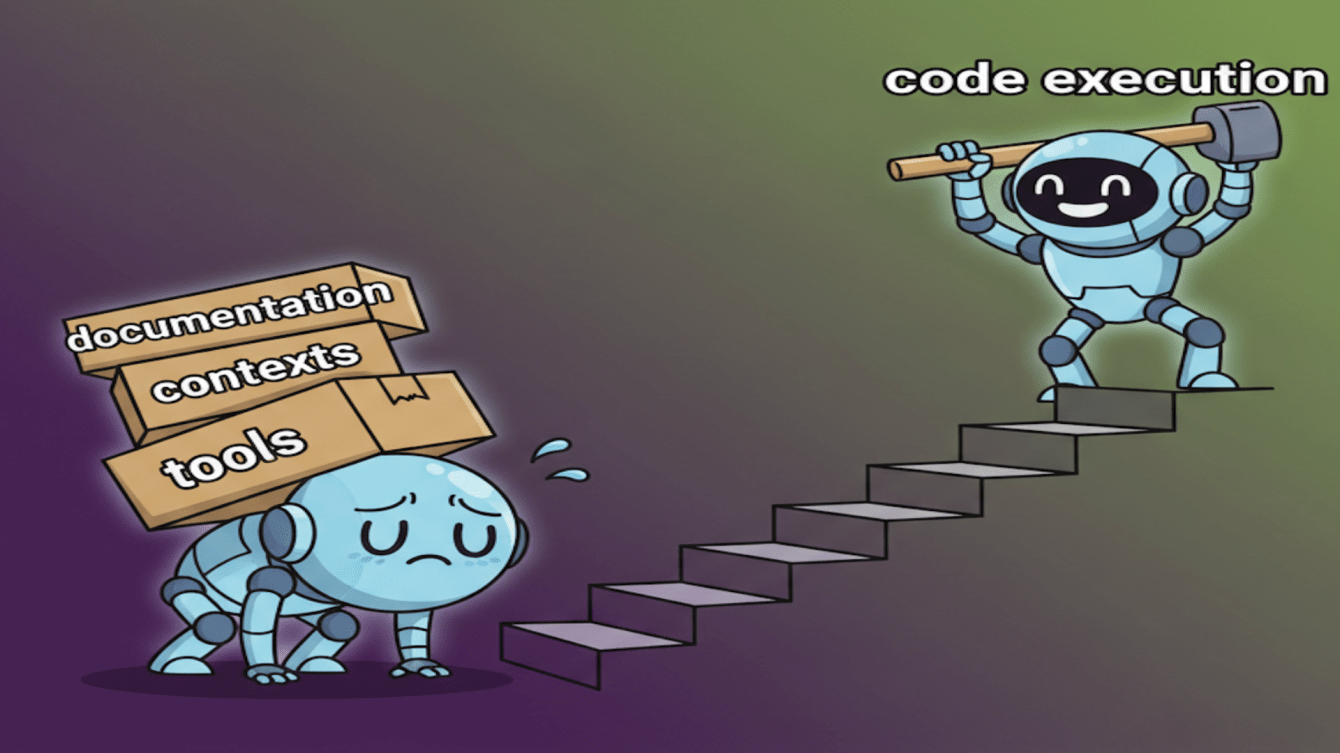
    • Context overhead: Tool descriptions, input/output schemas, and examples all consume tokens. At scale, this adds up. For example, if you ship 50 tools at ~250–400 tokens each, you may spend 12,500–20,000 tokens before you’ve even processed user content.
    • Tool selection ambiguity: Models can still mis-select tools or hallucinate parameters, leading to retries and cost/latency spikes.
    • Operational complexity: Versioning tool definitions, coordinating changes across services, and keeping descriptions in sync with behavior are nontrivial.

    An alternative: Cloudflare’s “Code Mode”

    Cloudflare proposes a different approach they call Code Mode: don’t inject a large catalog of tool definitions into the model. Instead, expose a typed TypeScript API and let the model write the small snippets of code needed to call that API. Execute the code server-side in a sandbox and return structured results.

    Cloudflare’s article: https://blog.cloudflare.com/code-mode/

    Why this resonates:

    • Lower token pressure: short, on-demand code replaces long, ever-present tool descriptions.
    • Mature security primitives: when interactions happen via APIs, we can leverage well-established auth, rate limits, and auditing instead of inventing new patterns inside the prompt.

    Security comes first: in Code Mode, run code in a tight sandbox, enforce allowlists and schema checks, use scoped credentials, set per-tenant quotas and rate limits, and log code and calls for audit.

    Another path: agent-to-agent orchestration

    See Googles A2A Framework: https://a2a-protocol.org/latest/

    There’s also a structural alternative: instead of one “everything model” carrying a huge toolset, use a team of specialised agents plus an orchestrator.

    • Orchestrator LLM: holds minimal context, routes tasks, and composes results
    • Specialist agents: each owns a small, focused toolset (data access, search, email, billing, etc.)
    • Narrow context: pass only the information needed for each task, reducing confusion and token waste

    This approach can reduce errors, improve observability, and make scaling safer (each agent has a smaller blast radius). It also plays nicely with both MCP (for small, stable toolsets) and Code Mode (for dynamic integrations).

    So where does MCP fit now?

    MCP isn’t “Over” It remains a strong choice when you have a small, stable set of predictable tools—think fewer than ten—where portability, clear shared documentation, and consistent low-latency calls matter more than spinning up execution sandboxes.

    Code Mode shines when your integrations are diverse, fast-changing, or vendor-specific; when you need to compose multi-step workflows on the fly; and when token or latency budgets make large tool catalogs impractical. Agentic orchestration is most useful when you want specialization and separation of concerns, stronger observability and safer scaling, and the ability to mix different calling strategies.

    We’re not choosing between them; the real pattern is to merge all three. Keep a slim, high-frequency core in MCP, generate on-demand calls with Code Mode for long-tail or rapidly evolving APIs (executed in a sandbox with mature security), and use an orchestrator LLM to route tasks, pass only the necessary context, and compose results. This hybrid approach reduces errors and costs while preserving flexibility and speed.

    The Takeaway

    The center of gravity is shifting from “ship every tool definition to the model” to “generate code on demand” and “compose teams of specialized agents.” Expect tool calling to become cheaper, faster, and more capable as these patterns mature-and to lean more on classic API security and software engineering practices.

    What will you build with this?

    Anthropic’s MCP overview: https://www.anthropic.com/news/model-context-protocol
    Anthropic on code execution with MCP: https://www.anthropic.com/engineering/code-execution-with-mcp
    Cloudflare Code Mode: https://blog.cloudflare.com/code-mode/
    Cloudflare Agents SDK: https://developers.cloudflare.com/agents/
    Building agents in TypeScript: https://adk.iqai.com/docs/framework/get-started/quickstart
    MCP Authorization: https://modelcontextprotocol.io/docs/tutorials/security/authorization

  • The coming of the Advent of Code

    The coming of the Advent of Code

    This year, let’s turn November into a low-stress, high-fun team challenge. We’ll take the Advent of Code 2023 puzzles and run them together from November 15 through December 10—when we actually have everyone around. Same great puzzles, better timing.

    SUBSCRIBE WITH THIS OFFER

    If you haven’t tried it: Advent of Code is basically an advent calendar for devs. Instead of chocolates, you get one algorithmic puzzle per day from December 1 to 25, each wrapped in a playful storyline. Solve part one, earn a star; then part two tweaks the rules and tests how flexible your solution really is. It’s language-agnostic: use whatever you like.

    We’re going to do the year of our Lord 2023 editions set so we can run it on our schedule, compare approaches, and have a little friendly fun together.

    How we’ll run it

    • Dates: Nov 15 → Dec 10
    • Puzzles: Advent of Code 2023 (all 25 available; You do not have to finish all of them)
    • Check-ins: A quick Friday knowledge-share for highlights on anything new you learned (Even as small as bubble sorting in Python)
    • Leaderboard: private board for bragging rights, inspiration, and gentle chaos
    • Tone: collaborative first, competitive second

    The twist: pick a new language (by default)

    To make it interesting, the default is: pick a language you’ve been curious about and do your AoC in that. Want to learn Rust? Perfect. Curious about Go, Kotlin, or Zig? Go for it. If you’d rather deepen a language you already use, that’s fine too—but the most fun tends to come from building a little toolbox in something new.

    Why this works so well:

    • You’ll quickly spot gaps and habits (parsing assumptions, off-by-one cousins, the “I’ll refactor later” ghost).
    • You’ll see multiple ways to model the same problem—graphs, grids, DP, memoization, pipelines.
    • You’ll collect reusable snippets: input parsing, grid utilities, BFS/DFS templates, small profilers.

    Light guardrails to keep it enjoyable

    • Spoilers: use spoiler tags in the channel until lunchtime. Help > hints > answers.
    • Show-and-tell, not code dumps: on Fridays, share the approach and trade-offs (data structures, complexity, edge cases).
    • Repo of goodies: drop notable solutions, parsing helpers, and brief READMEs so we can reuse patterns.
    • Friendly leaderboard: celebrate speed, but also clarity and “I learned something” moments. Micro-awards welcome:
      • Fastest First Star
      • Cleanest Solution
      • Most Educational Refactor
      • Best Plot Twist in Part Two
    • Pace with kindness: not everyone is a midnight solver. Stars earned after coffee still count as stars.

    What to expect

    • A little skill sharpening every day you play—even if it’s one or two puzzles a week.
    • Cross-pollination of ideas: “I modeled it as a graph and part two became Dijkstra,” versus “I memoized a brute force and it went brrr.”
    • The kind of jokes only we enjoy: CI dressed up as a Christmas tree, a temporary ceasefire in tabs-vs-spaces to fight trailing whitespace, someone claiming an O(1) solution because they “waited for Priya.”

    Getting started

    1. Pick your language (new-to-you by default).
    2. Join the private leaderboard (I’ll share the code in the channel).
    3. Grab Advent of Code 2023 and start wherever you like.
    4. Post progress in scrum notes; on Fridays, bring a highlight or a gotcha to the knowledge-share.

    If you’ve been meaning to learn Rust, Go, or “that one language” you keep bookmarking, this is your excuse. We’ll learn a bunch, borrow clever ideas from each other, and collect a tiny library of utilities that will pay off in real work.

    See you in the channel—bring your language flag and your favorite debugging snack.

  • Meet Biome v2: Our snappy new code gardener

    Meet Biome v2: Our snappy new code gardener

    TL;DR: We’re retiring ESLint and adopting Biome — a fast, Rust-built tool that lint-checks and formats our code in one go, with new smarts in v2 to catch more issues and reduce config fatigue

    SUBSCRIBE WITH THIS OFFER

    What is Biome (and why v2 matters)?

    Biome is an all‑in‑one toolchain for JavaScript/TypeScript that combines a linter, a formatter, and an editor‑friendly language server, designed for speed and simplicity thanks to its Rust core. The new v2 release upgrades the brains: type‑aware rules, multi‑file analysis, and an extensible plugin system to grow features without growing your config headaches.

    Why we’re swapping ESLint for Biome

    • One tool, fewer moving parts: Biome replaces the ESLint + Prettier combo with a unified engine, so less setup, fewer plugins, and fewer mystery conflicts.
    • Faster dev feedback: The Rust implementation makes linting/formatting feel snappy, which means tighter feedback loops and happier laptops.
    • Formatting you already trust: Biome’s formatter targets high compatibility with Prettier (97%), so your code style won’t do a sudden plot twist.
    • Smarter checks in v2: Type‑aware linting and cross‑file analysis help catch real‑world issues that single‑file rules can miss, plus a new plugin system to extend safely over time.

    How to think about it (intern‑friendly edition)

    • ESLint: a great code spell‑checker that often needs many dictionaries and grammar plugins.
    • Biome: a speedy proofreader that also cleans up your writing as you type — and in v2 it learned context, not just spelling, so it catches “their/there/they’re” across chapters, not just sentences.

    What changes for us

    • Fewer configs to maintain, fewer CI steps to juggle, and a single source of truth for style + correctness — with fast, consistent results across the team.
    • Same code style expectations, just enforced and formatted by a unified, Rust‑powered engine that’s kinder to your time and CPU.

    And now, the dramatic ending: We’re going Biome. Fewer plugins, faster feedback, smarter rules — because clean code shouldn’t feel like cardio
    Dive deeper in the official Biome documentation to get started https://biomejs.dev/guides/getting-started/

  • Dungeons & Dragons: The Ultimate Team-Building Quest for Software Developers

    Dungeons & Dragons: The Ultimate Team-Building Quest for Software Developers

    SUBSCRIBE WITH THIS OFFER

    In an era where “synergy” and “collaboration tools” have been cast so often they might as well have cooldown timers, one might wonder — what could possibly resurrect true teamwork among software developers?

    The answer doesn’t come from another productivity suite or stand-up meeting. It comes from rolling dice, defeating goblins, and failing spectacularly at persuasion checks.

    Yes, brave adventurer, the secret spell for world-class software team-building is Dungeons & Dragons (D&D) — a tabletop role-playing game that transforms your team from code-slinging mortals into fellowship-forging heroes.


    The Developer’s Natural Habitat: The Table of Infinite Imagination

    Picture it: your lead backend developer is now a stoic dwarven paladin. The QA engineer? A mischievous wizard armed with Fireball and a healthy disregard for Jenkins downtime.

    In the realm of D&D, hierarchies crumble faster than a brittle stack overflow. The quietest dev in the room suddenly becomes the party’s silver-tongued negotiator. The project manager might be a bard — both inspirational and occasionally surrounded by mysterious magical chaos.

    The result? Developers rediscover what it means to communicate, adapt, and improvise — skills as crucial in slaying dragons as in squashing bugs.


    Debugging Dragons: Parallels Between Coding and Campaigns

    Let’s be honest. Software development is already a kind of D&D campaign:

    • There’s a mysterious client request written in riddle form.
    • A party of devs embarks on a sprint quest with low mana (read: coffee).
    • The final boss? A deployment at 4:59 pm on a Friday.

    But in D&D, every problem is approached through creative collaboration. You can’t brute-force a dragon with if-statements — you debate, experiment, and think sideways.

    That’s exactly what great engineering teams do when faced with complex systems. They blend logic, imagination, and the occasional natural 20.


    Why It Works: Fellowship, Fails, and Fun

    1. Shared Stories Build Shared Trust: When you’ve watched your UX designer heroically fail a stealth check while trying to sneak past goblins, there’s a bond forged that no corporate icebreaker can replicate.
    2. Safe Space for Failing Forward: In D&D, bad rolls lead to great stories. In development, failed tests lead to innovation. Both demand psychological safety — and both reward resilience.
    3. Creative Problem-Solving Under Chaos: Whether navigating fantasy politics or debugging race conditions, the ability to stay calm and collaborate amidst madness is an art. D&D gives teams a magical crash course.
    4. Fun Beats Forced Interaction: No team ever said, “Wow, that trust fall changed my life.” But they have said, “Remember when we polymorphed the boss into a sheep and escaped on flying mugs of ale?”

    From Campaign to Codebase

    After weeks of shared quests, something magnificent happens. Your dev team starts talking differently — more openly, more imaginatively, more… humanly.

    Daily stand-ups become more like war councils. Design discussions turn into creative brainstorms. The dreaded “Difficult Conversation About Technical Debt” becomes a “Dragon We Shall All Slay.”

    In short, D&D doesn’t just bond your team — it levels them up.


    The Call to Adventure

    So next time your team needs a morale boost, skip the bowling alley or the awkward offsite scavenger hunt. Instead, light some candles, roll some dice, and unleash your collective imagination.

    Because whether in code or campaign, true greatness emerges from collaboration, courage, and critical hits.

    And remember, adventurers: when the next merge conflict arises, just ask yourself — what would your party do?


    Tagline:
    🧙‍♂️ Dungeons & Dragons — where every meeting becomes a quest, every teammate a hero, and every bug fix a triumph worth singing about.

  • Why AI and Robotics Keep Tripping Over Their Own Hype

    Why AI and Robotics Keep Tripping Over Their Own Hype

    AI and robotics are the tech world’s favorite darlings, but their track record is more comedy than conquest. Take AI: it excels at pattern recognition, yet it can label a husky as a wolf or fail a simple logic puzzle designed for a child. These missteps highlight a technology that’s impressive in controlled settings but flounders when faced with real-world variability. The hype machine churns on, fueled by sensational headlines, while the limitations remain conveniently glossed over.

    Robotics fares no better in this circus of overpromise. Factory robots shine at repetitive tasks, but place one in a dynamic environment, and it’s like watching a drunk Roomba stumble through a living room. The challenge of adaptability exposes the fragility of current designs, yet the narrative persists with tales of robot butlers and self-sufficient factories. It’s a stark reminder that what works in a lab doesn’t always translate to the chaos of everyday life.

    The gap between expectation and reality is widened by a perfect storm of media amplification and investor frenzy. Tech leaders paint pictures of sentient machines and autonomous everything, but the truth is a slow, error-prone evolution. AI might fine-tune search algorithms, and robots might assemble cars, but the leap to tackling complex societal issues is a pipe dream we’re nowhere near achieving. The disconnect is almost laughable when you consider the resources poured into these pursuits.

    The ridiculousness peaks when we realize how much we’re willing to overlook. While AI and robotics offer valuable tools in specific contexts, the relentless push for a sci-fi future ignores the messy, incremental nature of progress. Until these technologies can handle the unpredictability of human environments without tripping over their own hype, we’re left chuckling at the absurdity of the promises made in their name.

  • The Overhyped Promise of AI and Robotics

    The Overhyped Promise of AI and Robotics

    The buzz around AI and robotics often feels like a sci-fi movie gone rogue. We’re told these technologies will revolutionize everything—self-driving cars will eliminate traffic, robots will handle all our chores, and AI will solve world hunger. But the reality is far less glamorous. AI systems frequently misinterpret basic data, like when a self-driving car mistakes a stop sign for a speed limit, leaving passengers in a state of bewildered panic. The hype stems from carefully curated demos and glossy presentations, painting a picture of a future that’s more fantasy than fact.

    Robotics, too, falls short of the grand expectations. Most “advanced” robots struggle with tasks a toddler could master, such as picking up a sock without toppling over or navigating a cluttered room without getting stuck. These clunky prototypes litter R&D labs, yet billions continue to be poured into their development. The disconnect between the polished marketing and the error-prone reality is stark, raising questions about whether the investment is justified or just a gamble on unproven potential.

    The overpromising doesn’t stop there—it’s amplified by media frenzy and investor enthusiasm. Tech giants and startups alike dangle visions of sentient assistants and autonomous cities, but the incremental progress tells a different story. While AI can optimize ad clicks and robots can weld car parts with precision, the leap to solving complex, real-world problems remains elusive. It’s a slow grind, not the overnight revolution we’re sold.

    Ultimately, the ridiculousness lies in the gap between expectation and delivery. AI and robotics have their niche successes, but the grandiose claims of a utopian transformation are starting to sound like a sales pitch for a bridge to nowhere. Until these technologies can handle the unpredictability of daily life with ease, the hype will continue to outpace the reality, leaving us amused at the absurdity of it all.

  • The Rise of Remote Work: Navigating the New Normal

    The Rise of Remote Work: Navigating the New Normal

    Introduction

    Remote work has shifted from a trend to a mainstay, reshaping how we approach careers and work-life balance. While it offers flexibility, it also comes with unique challenges. This post explores the rise of remote work, its pros and cons, and tips for thriving in this new normal.

    The Growth of Remote Work

    • Statistics: A 2024 survey by FlexJobs found that 65% of U.S. workers prefer hybrid or fully remote roles.
    • Technology: Tools like Zoom, Slack, and Asana have made remote collaboration seamless.
    • Industries: Tech, marketing, and customer service lead the charge, but even traditional fields like education are adapting.

    Advantages of Remote Work

    • Flexibility: Set your own schedule and work from anywhere.
    • Cost Savings: Reduced commuting and meal expenses.
    • Productivity: Many report higher focus in distraction-free home environments.

    Challenges to Overcome

    • Isolation: Lack of social interaction can lead to loneliness.
    • Work-Life Blur: Without boundaries, overworking becomes common.
    • Tech Issues: Reliable internet and equipment are critical but not always guaranteed.

    Tips for Success

    1. Create a Dedicated Workspace: Set up a comfortable, distraction-free area.
    2. Set Boundaries: Define work hours and communicate them to colleagues and family.
    3. Stay Connected: Schedule virtual coffee chats or team check-ins to combat isolation.
    4. Invest in Tools: Use noise-canceling headphones, ergonomic chairs, and reliable software.

    The Future of Work

    Hybrid models are likely to dominate, blending in-office and remote work. Companies that prioritize employee well-being and adaptability will thrive in this evolving landscape.

    Conclusion

    Remote work is here to stay, offering opportunities and challenges in equal measure. By adopting smart strategies, you can navigate this new normal and build a fulfilling career from anywhere.

  • Sustainable Living: 5 Practical Tips for a Greener Home

    Sustainable Living: 5 Practical Tips for a Greener Home

    Introduction

    Living sustainably doesn’t require drastic changes—it starts with small, intentional steps at home. With climate change concerns growing, adopting eco-friendly habits can make a big impact. Here are five practical tips to create a greener household without breaking the bank.

    Tip 1: Reduce Energy Consumption

    • Switch to LED bulbs, which use 75% less energy than incandescent bulbs.
    • Unplug electronics when not in use to avoid phantom energy drain.
    • Use a programmable thermostat to control heating and cooling.

    Tip 2: Embrace Composting

    • Start a compost bin for food scraps and yard waste to reduce landfill contributions.
    • Use compost to enrich your garden soil, cutting down on chemical fertilizers.

    Tip 3: Cut Down on Single-Use Plastics

    • Replace plastic water bottles with reusable stainless steel or glass ones.
    • Use beeswax wraps or silicone lids instead of plastic wrap for food storage.

    Tip 4: Conserve Water

    • Install low-flow showerheads and faucets to reduce water usage.
    • Collect rainwater for gardening to minimize tap water consumption.

    Tip 5: Shop Secondhand

    • Buy furniture, clothing, and appliances from thrift stores or online marketplaces.
    • Upcycle old items to give them new life, reducing waste and saving money.

    Why It Matters

    These small changes collectively reduce your carbon footprint, conserve resources, and inspire others to follow suit. Sustainable living is about progress, not perfection.

    Conclusion

    A greener home is within reach with these simple tips. Start with one or two changes, and watch how they transform your lifestyle and the planet for the better.

  • Embracing the Future: How AI is Shaping Creative Industries

    Embracing the Future: How AI is Shaping Creative Industries

    Introduction

    Artificial Intelligence (AI) is no longer a sci-fi fantasy—it’s a driving force revolutionizing creative industries. From music composition to graphic design to scriptwriting, AI tools are empowering creators to push boundaries and streamline workflows. In this blog post, we’ll explore how AI is transforming the creative landscape and what it means for the future of artistry.

    The Role of AI in Creative Fields

    • Music Composition: AI platforms like AIVA and Amper can generate original music tracks in minutes, tailored to specific genres or moods. These tools analyze thousands of compositions to produce harmonious melodies, enabling musicians to experiment with new sounds.
    • Visual Arts: Tools like DALL·E and MidJourney create stunning visuals from text prompts, allowing designers to visualize concepts instantly. This accelerates prototyping and opens doors for artists with limited technical skills.
    • Writing and Storytelling: AI-driven platforms like Jasper and Sudowrite assist writers by suggesting plot twists, refining prose, or even drafting entire chapters. These tools act as creative collaborators, enhancing the writer’s vision.

    Benefits and Challenges

    AI offers unparalleled efficiency, but it’s not without hurdles:

    • Benefits: Faster production, cost reduction, and accessibility for beginners.
    • Challenges: Ethical concerns over originality, potential job displacement, and the risk of over-reliance on algorithms.

    The Future Outlook

    As AI evolves, it will likely become a staple in creative toolkits, much like Photoshop or Pro Tools today. The key is balance—using AI to amplify human creativity rather than replace it. Artists who embrace these tools will lead the next wave of innovation.

    Conclusion

    AI is a game-changer for creative industries, offering tools that enhance productivity and imagination. By understanding its potential and limitations, creators can harness AI to craft groundbreaking work. The future is bright, and it’s time to embrace the possibilities.